GENERAL CHEMISTRY / STUDY NOTES WORK IN PROGRESS
Chemical bonding &
molecular geometry
A practical route from a Lewis structure to a three-dimensional shape, then to an answer about molecular polarity. These are the ideas usually taught together in an introductory college chemistry unit.
This study guide is still being expanded. The core notes below are available now; more worked examples and exercises will follow.
Start with the Lewis structure
Count valence electrons, connect the atoms, complete terminal octets, and place the remaining electrons on the central atom. If the center still lacks an octet, consider multiple bonds. A Lewis structure tells you which atoms are bonded; it does not by itself show every bond in its final spatial direction.

Oxygen makes two O–H bonds and has two lone pairs. Four electron regions surround O, even though only two atoms are attached to it. Rotate the H₂O model ↗
Draw formal charges where needed. For example, a useful nitric acid contributor is H–O–N⁺(=O)–O⁻; the two non-protonated oxygen positions exchange through resonance. See HNO₃ ↗
Predict the shape, then verify it in 3D
VSEPR counts electron regions around a central atom. A single, double, or triple bond counts as one region; each lone pair counts as one region. Two regions suggest a linear arrangement, three trigonal planar, and four tetrahedral electron geometry. Lone pairs occupy regions but are omitted when naming the molecular shape.
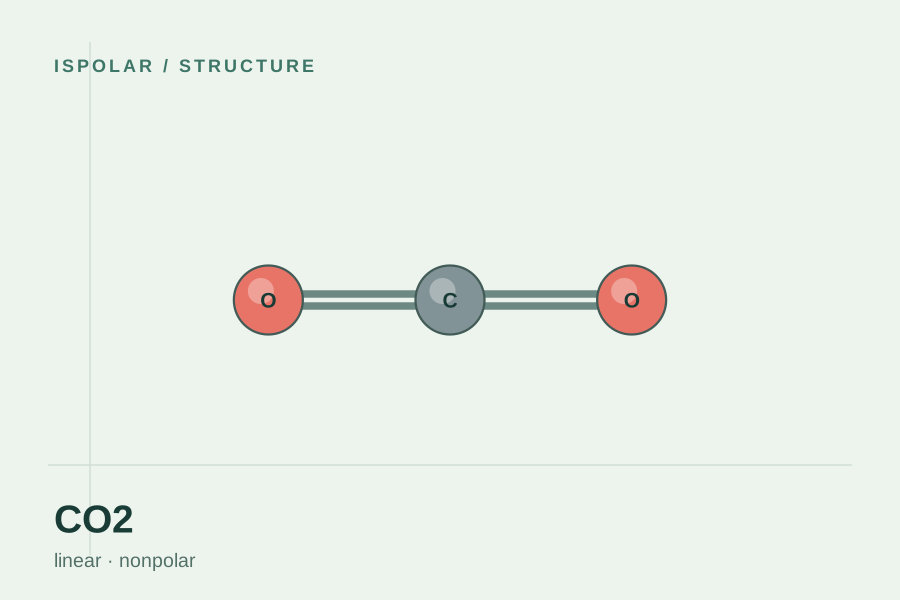 CO₂ · AX₂Linear
Two bonding regions at C, no lone pairs at C. The O=C=O directions oppose each other.
View CO₂ ↗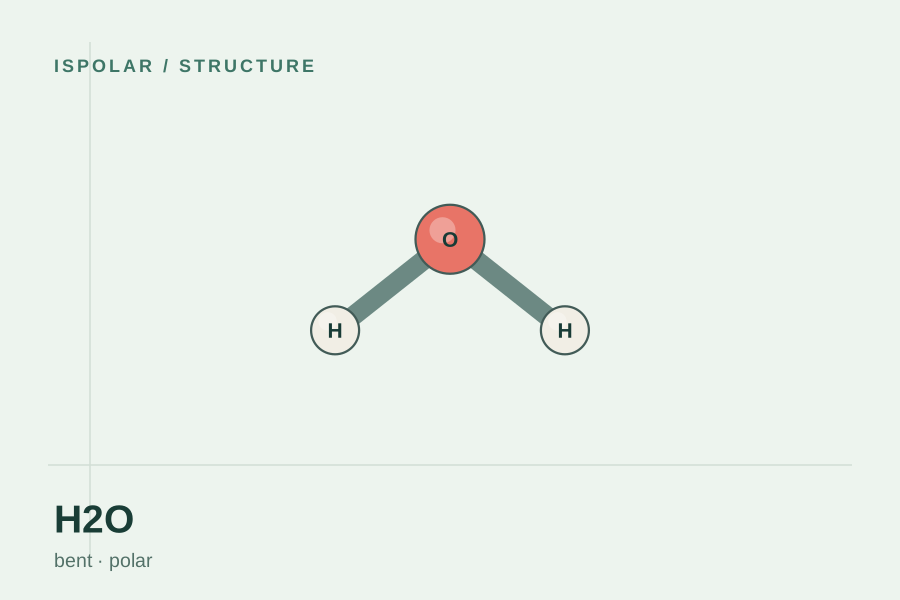 H₂O · AX₂E₂Bent
Two bonds and two lone pairs at O. The H–O–H bonds do not point in opposite directions.
View H₂O ↗Actual angles can depart from ideal VSEPR values, especially when lone pairs, multiple bonds, or ring strain matter. Our 3D viewer shows model geometry; it is not a replacement for an experimentally measured angle. Use the VSEPR shape guide for the full AXE table.
Ask whether the vectors cancel
A polar bond has an uneven electron distribution. Molecular polarity also depends on the direction of every bond dipole in space. Equal dipoles cancel when symmetry points them in opposing directions; otherwise the molecule can retain a net dipole. Do not decide from a single bond or from the molecular formula alone.
 BF₃Nonpolar molecule
The three B–F bonds are polar, but their trigonal-planar directions cancel.
Inspect BF₃ ↗ NH₃Polar molecule
Three N–H bonds form a trigonal pyramid; the bond contributions do not cancel.
Inspect NH₃ ↗“Nonpolar” in introductory organic chemistry can be a practical classification for hydrocarbons with only small dipoles. It does not always mean an exactly zero measured dipole. Try the polarity checker ↗
Watch for isomers and flexible molecules
Two substances can share a formula while differing in connectivity or geometry. In cis-1,2-dichloroethene, the chlorine substituents sit on the same side of a rigid C=C bond; in the trans isomer they sit on opposite sides. This changes whether the C–Cl dipoles reinforce or cancel.
 C₂H₂Cl₂ · CISPolar
Same-side chlorine substituents reinforce their dipole components.
View cis isomer ↗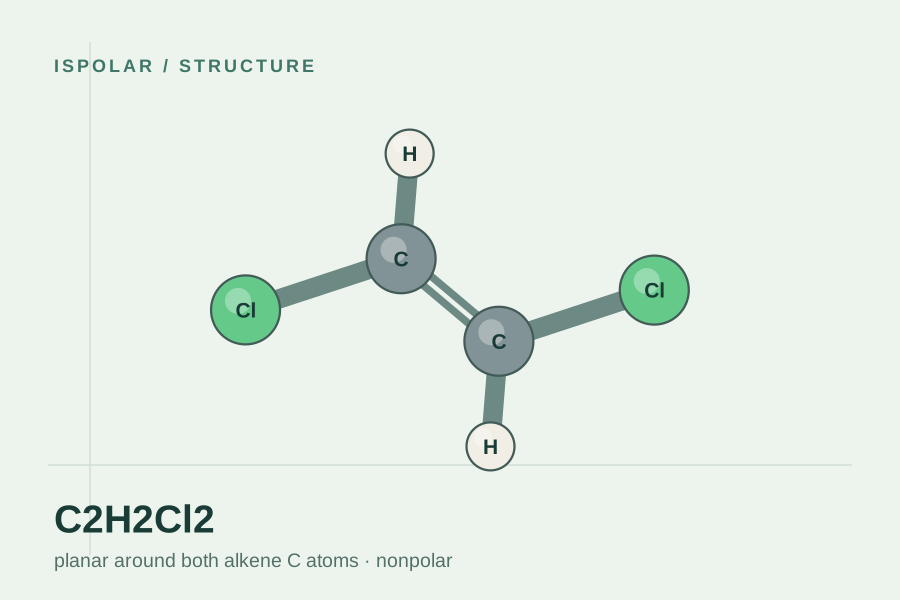 C₂H₂Cl₂ · TRANSNonpolar
Opposite substituents give cancellation in the planar trans arrangement.
View trans isomer ↗Single bonds can rotate, so a 3D conformer is one pose of a flexible molecule. 1,2-dichloroethane is a useful case: the C–Cl directions change as the C–C bond rotates. Resonance is different: contributors change the electron drawing, not the atomic connectivity.
Check your prediction
- Draw H₂O and CO₂. Count the electron regions at each center before naming the shapes.
- Explain why the three polar B–F bonds in BF₃ leave no net dipole.
- Compare cis- and trans-1,2-dichloroethene without changing their formulas.
- Open the 3D model and turn on angles to see the geometry behind your answer.