MOLECULAR POLARITYFIELD NOTE 119 / 175
Is HCN polar or nonpolar?
HCN is polar despite being linear: its H and N ends are different, so the bond contributions do not cancel.
Hydrogen Cyanide · linear
The molecule in space
Drag to turn the molecule. Show angles to read the model geometry.
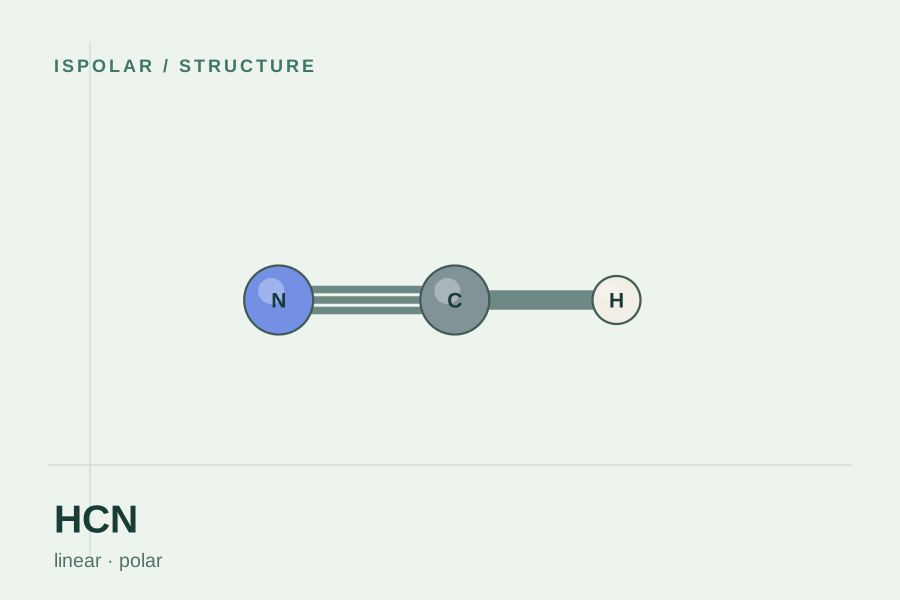
01 / MODEL RECORDPubChem 3D coordinates. Atom sizes and bond thickness are illustrative.How model data is used ↗
Why HCN is polar
Hydrogen cyanide is linear (H–C≡N). Nitrogen (3.04) pulls electrons strongly toward itself through the triple bond, while the C–H bond dipole adds in the same direction.
What to notice
HCN is straight, but its ends are H and N rather than identical atoms. Linear does not automatically mean nonpolar.
Common questions about HCN
- 01
What does the Lewis structure of HCN show?
The common structure is H–C≡N: a C–H single bond and a C≡N triple bond. N has one lone pair.
- 02
What is the molecular geometry of HCN?
HCN has a linear molecular geometry. The 3D model shows representative bond angles of 180°. These angles come from the displayed model coordinates.
- 03
What is the molar mass of HCN?
HCN has an approximate molar mass of 27.03 g/mol, calculated from its formula using abridged standard atomic weights. Natural isotope variation can change the last digits.