MOLECULAR POLARITYFIELD NOTE 105 / 175
Is Ethylamine (C2H7N) polar or nonpolar?
Ethylamine (C2H7N) is polar because its terminal –NH2 group has a nitrogen lone pair and polar C–N and N–H bonds.
Ethylamine · tetrahedral at C; pyramidal at N
The molecule in space
Drag to turn the molecule. Show angles to read the model geometry.
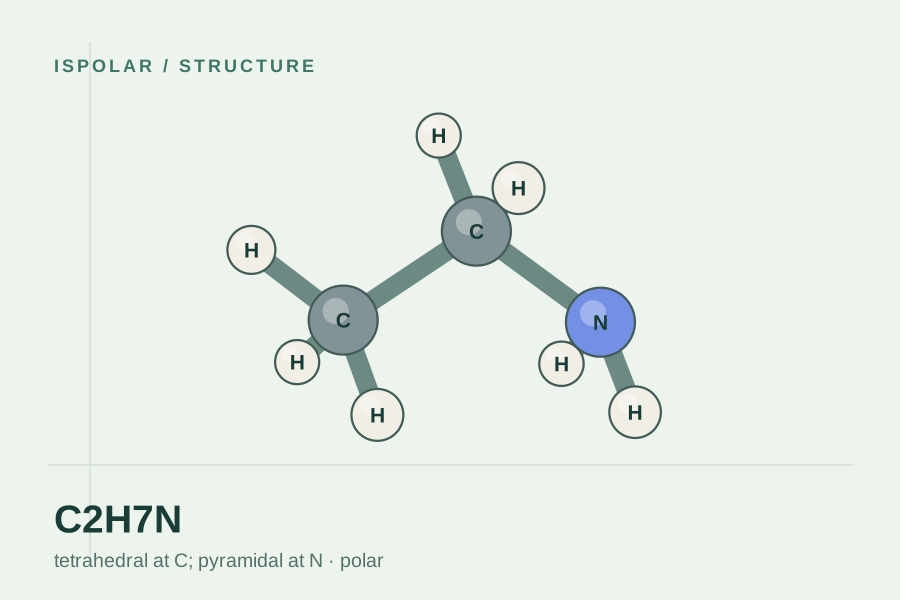
01 / MODEL RECORDPubChem 3D coordinates. Atom sizes and bond thickness are illustrative.How model data is used ↗
Why C2H7N is polar
Ethylamine is CH3–CH2–NH2. Nitrogen makes three single bonds and keeps one lone pair, so its local arrangement is pyramidal. The amino end draws electron density differently from the ethyl end, leaving a molecular dipole.
What to notice
The two carbons are approximately tetrahedral, but the nitrogen is pyramidal. Applying a single VSEPR shape label to the entire ethylamine molecule would hide that difference.
Common questions about Ethylamine (C2H7N)
- 01
What does the Lewis structure of Ethylamine (C2H7N) show?
The connectivity is CH3–CH2–NH2. Nitrogen bonds to one carbon and two hydrogens and has one lone pair; both carbons have four bonds.
- 02
What is the molecular geometry of Ethylamine (C2H7N)?
Ethylamine (C2H7N) has a tetrahedral at C; pyramidal at N molecular geometry. The 3D model shows representative bond angles of 109.6° and 105.9° and 111.2°. These angles come from the displayed model coordinates.
- 03
What is the molar mass of Ethylamine (C2H7N)?
C2H7N has an approximate molar mass of 45.09 g/mol, calculated from its formula using abridged standard atomic weights. Natural isotope variation can change the last digits.