MOLECULAR POLARITYFIELD NOTE 23 / 175
Is C2H5I polar or nonpolar?
Iodoethane (C2H5I) is polar because the C–I substituted end is chemically different from the methyl end.
Iodoethane · tetrahedral at each C
The molecule in space
Drag to turn the molecule. Show angles to read the model geometry.
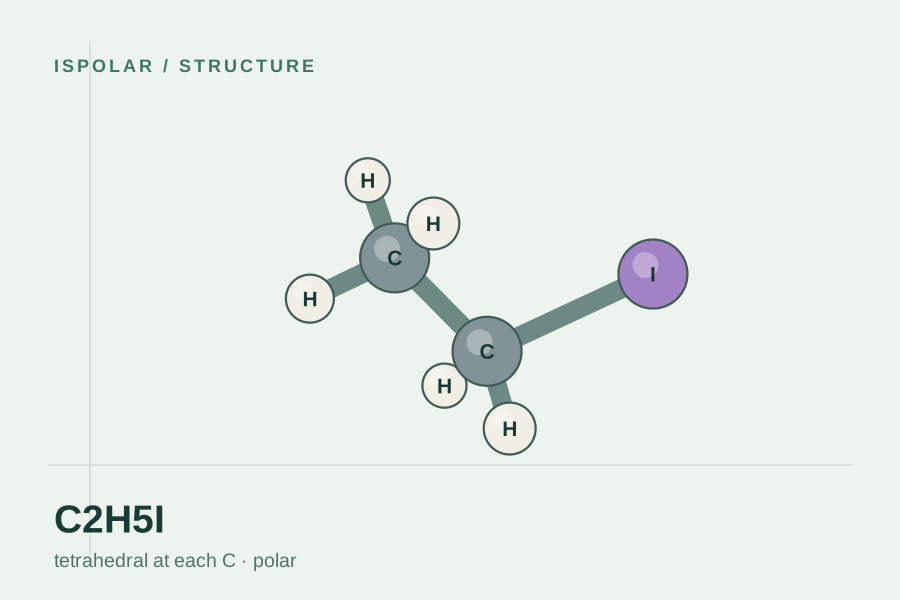
01 / MODEL RECORDPubChem 3D coordinates. Atom sizes and bond thickness are illustrative.How model data is used ↗
Why C2H5I is polar
Iodoethane has a terminal iodine atom bonded to a tetrahedral carbon. The substituted end differs from the opposite CH3 end, yielding a molecular dipole despite iodine being less electronegative than fluorine.
What to notice
A C–I bond is less strongly polarized than a C–F bond; the presence of a halogen alone does not tell you the dipole magnitude.
Common questions about C2H5I
- 01
What does the Lewis structure of C2H5I show?
The connectivity is CH3–CH2–I. Each carbon completes four single bonds and iodine has three lone pairs.
- 02
What is the molecular geometry of C2H5I?
C2H5I has a tetrahedral at each C molecular geometry. The 3D model shows representative bond angles of 110.9° and 109.8° and 109.5°. These angles come from the displayed model coordinates.
- 03
What is the molar mass of C2H5I?
C2H5I has an approximate molar mass of 155.96 g/mol, calculated from its formula using abridged standard atomic weights. Natural isotope variation can change the last digits.