MOLECULAR POLARITYFIELD NOTE 155 / 175
Is Phenol (C6H6O) polar or nonpolar?
Phenol (C6H6O) is polar because its –OH substituent breaks benzene's six-way ring symmetry.
Phenol · planar aromatic ring; bent at hydroxyl O
The molecule in space
Drag to turn the molecule. Show angles to read the model geometry.
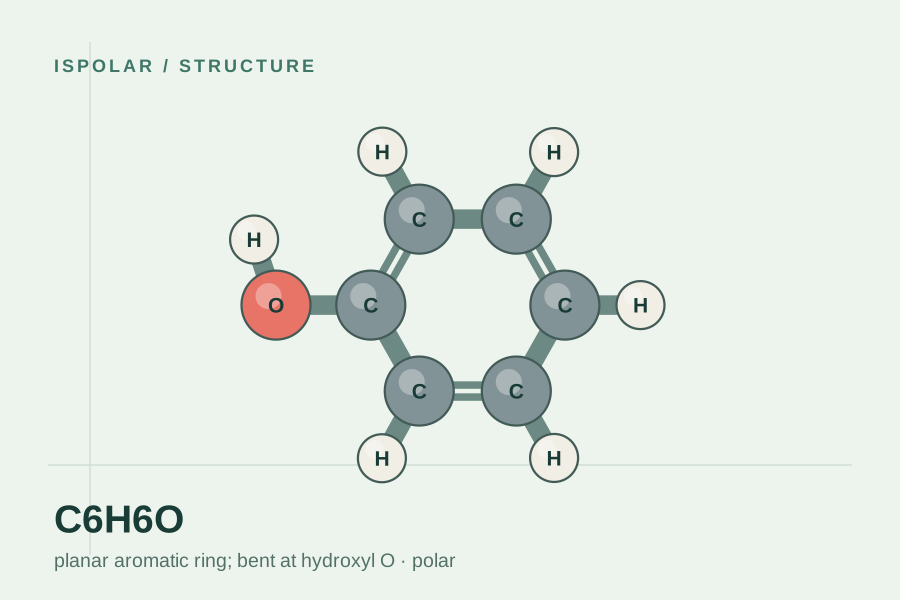
01 / MODEL RECORDPubChem 3D coordinates. Atom sizes and bond thickness are illustrative.How model data is used ↗
Why C6H6O is polar
Phenol is a benzene ring with one hydrogen replaced by –OH. The C–O and O–H bonds pull electron density toward the hydroxyl group, so the six ring positions are no longer equivalent and the molecular dipole is not zero.
What to notice
Benzene is nonpolar because every ring position matches the others. Phenol keeps an aromatic ring but introduces one oxygen-bearing position, changing the symmetry and polarity.
Common questions about C6H6O
- 01
What does the Lewis structure of C6H6O show?
The structure is C6H5–O–H. The six-carbon ring has alternating double bonds in one Kekulé drawing; oxygen has two single bonds and two lone pairs.
- 02
What is the molecular geometry of C6H6O?
C6H6O has a planar aromatic ring; bent at hydroxyl O molecular geometry. The 3D model shows representative bond angles of 108.9° and 120°. These angles come from the displayed model coordinates.
- 03
What is the molar mass of C6H6O?
C6H6O has an approximate molar mass of 94.11 g/mol, calculated from its formula using abridged standard atomic weights. Natural isotope variation can change the last digits.