MOLECULAR POLARITYFIELD NOTE 130 / 175
Is Isopropanol (C3H8O) polar or nonpolar?
Isopropanol (C3H8O) is polar because the middle-carbon –OH group creates polar C–O and O–H bonds.
Isopropanol · tetrahedral at C; bent at hydroxyl O
The molecule in space
Drag to turn the molecule. Show angles to read the model geometry.
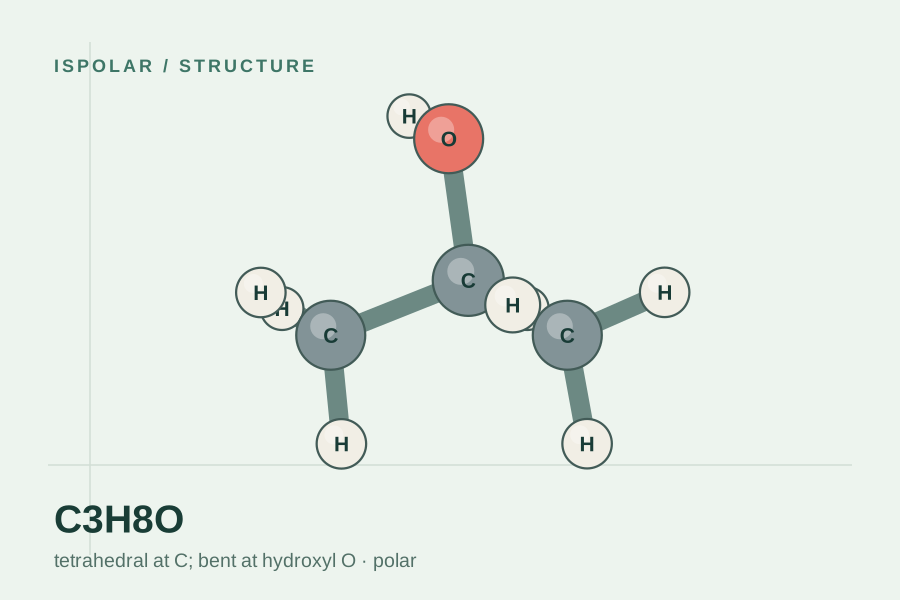
01 / MODEL RECORDPubChem 3D coordinates. Atom sizes and bond thickness are illustrative.How model data is used ↗
Why C3H8O is polar
In 2-propanol, oxygen is bonded to the central carbon and to hydrogen. Its two lone pairs and the electronegativity difference across C–O and O–H produce an uneven charge distribution that the two methyl groups do not cancel.
What to notice
Isopropanol and 1-propanol share the formula C3H8O but connect the –OH group at different positions. A formula alone cannot distinguish these two 3D structures.
Common questions about Isopropanol (C3H8O)
- 01
What does the Lewis structure of Isopropanol (C3H8O) show?
The structure is CH3–CH(OH)–CH3. The middle carbon bonds to two methyl groups, H, and O; oxygen bonds to C and H and has two lone pairs.
- 02
What is the molecular geometry of Isopropanol (C3H8O)?
Isopropanol (C3H8O) has a tetrahedral at C; bent at hydroxyl O molecular geometry. The 3D model shows representative bond angles of 107.9° and 109.2° and 107.4°. These angles come from the displayed model coordinates.
- 03
What is the molar mass of Isopropanol (C3H8O)?
C3H8O has an approximate molar mass of 60.10 g/mol, calculated from its formula using abridged standard atomic weights. Natural isotope variation can change the last digits.