MOLECULAR POLARITYFIELD NOTE 15 / 175
Is Bromobenzene (C6H5Br) polar or nonpolar?
Bromobenzene (C6H5Br) is polar because its single C–Br bond breaks the equivalent positions of benzene.
Bromobenzene · planar aromatic ring; trigonal planar at ring C
The molecule in space
Drag to turn the molecule. Show angles to read the model geometry.
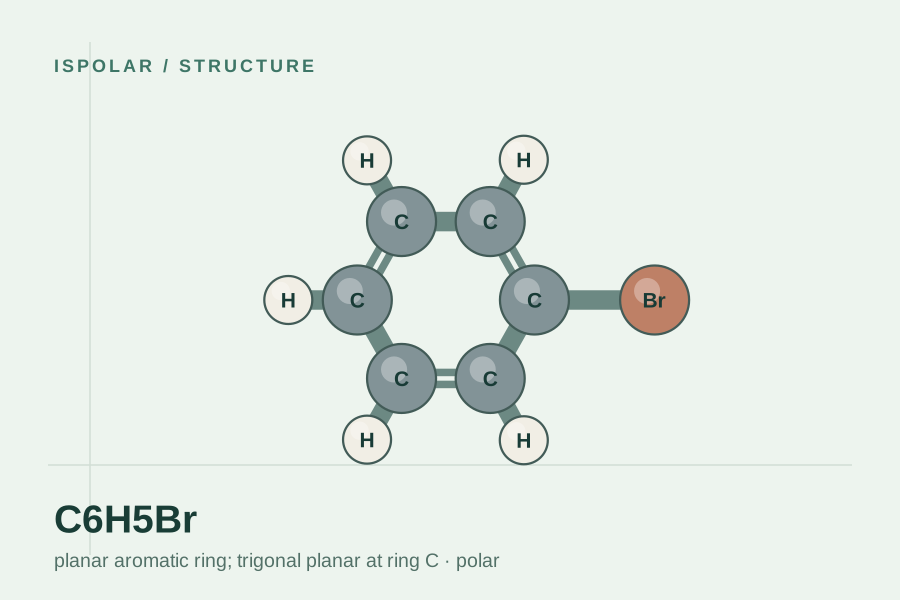
01 / MODEL RECORDPubChem 3D coordinates. Atom sizes and bond thickness are illustrative.How model data is used ↗
Why C6H5Br is polar
One bromine replaces a hydrogen on the aromatic ring. Bromine's C–Br bond and the five C–H directions do not have matching dipole strengths, so the molecule retains a net dipole even though the ring is nearly planar.
What to notice
Fluorobenzene, chlorobenzene, and bromobenzene have the same one-substituent ring pattern. The halogen changes bond polarity, while the broken benzene symmetry is shared.
Common questions about C6H5Br
- 01
What does the Lewis structure of C6H5Br show?
The structure is C6H5–Br with an aromatic six-carbon ring. A Kekulé drawing has three alternating C=C bonds; Br has three lone pairs.
- 02
What is the molecular geometry of C6H5Br?
C6H5Br has a planar aromatic ring; trigonal planar at ring C molecular geometry. The 3D model shows representative bond angles of 120°. These angles come from the displayed model coordinates.
- 03
What is the molar mass of C6H5Br?
C6H5Br has an approximate molar mass of 157.01 g/mol, calculated from its formula using abridged standard atomic weights. Natural isotope variation can change the last digits.